A function f(x,y) is bilinear if the following is true, where m any constant:
- f(mx,y)=mf(x,y)
- f(x,my)=mf(x,y)
- f(x1+x2,y)=f(x1,y) + f(x2,y)
- f(x,y1+y2)=f(x,y1) + f(x,y2)
Yhis extends what “linear” did for f(x) to a function with two variables. For an example, we test f(x,y) = xy.
- f(mx,y) = (mx)y = mxy
- f(x,my) = x(my) = mxy
- mf(x,y) = m(xy) = mxy
- f(x1+x2,y) = (x1+x2)y = x1y + x2y
- f(x1,y) + f(x2,y) = x1y + x2y
- f(x,y1+y2) = x(y1+y2) = xy1 + xy2
- f(x,y1) + f(x,y2) = xy1 + xy2
Two 3D graphs have been made to show f(x,y)=xy.
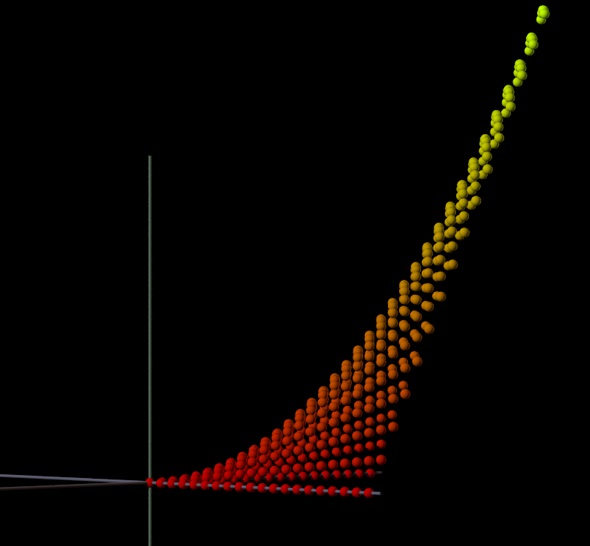
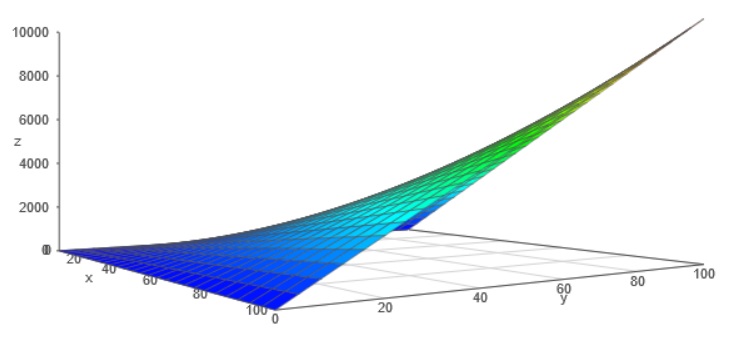
If you take a slice that runs parallel to the x-axis (or the y-axis) you get a function that is linear (example: (2,0,0), (2,1,2), (2,2,4), (2,3,6), (2,4,8), (2,5,10), etc. However, if you “go up the middle” (0,0,0), (1,1,1), (2,2,4), etc. and you can see that the “run” is 
Appendix A
The Dot Product is bilinear.
- Let
- Let


 Rob Sterling