Special Relativity, also known as the Special Theory of Relativity, is a relationship between space and time.
Challenge statement: Assume an experiment with a starting point and a stopping point: if two bodies, A and B, are moving at the same velocity and A moves twice as far as B, then time for B is half as much as time for A because distance for B.
“Special Relativity” sounds interesting, but we should mention that the name is deceiving. Special Relativity isn’t called special for being “better”–it is called special for being “limited”. Special Relativity doesn’t allow there to be any gravity and since any two objects will cause a gravitational attraction, one on the other, we can only have one object in the system. That means our starship Enterprise, built for a five year mission, has nothing to investigate.
Despite this extreme disappointment (no blueskin women for a young captain), we find something interesting in Special Relativity–we find math that says two clocks can run at different speeds if they are moving at different velocities.
- The laws of physics are invariant (i.e., identical) in all inertial frames of reference
- the speed of light in a vacuum is the same for all observers, regardless of the motion of the light source or observer.
OK, let’s do the calculation:
Velocity relates a change it position to a change in time. As an easy example, if we travel 100 km/hr for 2 hours, we travel 200 km. Here is the equation:

Now if we start at position zero and the clock starts at time=0 then 


for the work below both 


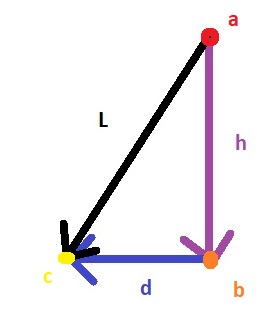
- In the stationary frame of reference, light travels a distance h over an amount of time
- In the moving frame of reference, the train travels a distance d over an amount of time
- In this moving frame of reference, light must travel a distance L over an amount of time
- The train is moving in the x-direction.
- If we shine a light from one side of the train to the other, it is moving in the y direction.
OK, now to try to make more sense of it. I watched a different video and the person elaborated more. It might help for us to say we are shining a beam of light from one side of the train to the other, a distance h. To us, that light only moves in the y-direction (across the train).
To the person on the ground, they see the light moving in both the y direction and the x direction because the light, launched on the train, is also moving in the x-direction. In the time it takes for the light to move across the train a distance h,in the y-direction, it also moves a distance d, in the x-direction. The length of d will be determined by multiplying the velocity of the train and time according to the moving frame of reference. We need this because if two things moving at the same velocity travel different distances then they need different amounts of time.
One more thing and this will seem backwards at first, please bear with us. We are telling the story relative to the person on the train. That person is in the stationary environment. That is why when they shine the light, for them, it only moves in the y-direction.
If the train is the stationary frame, then the ground is moving at the velocity v. This is why the person on the ground sees the light moving in both x and y directions.
If we say that time for the person on the ground was more, that means time for the person on the train was less. This agrees with the postulate that increasing velocity will make time slow down.


Compare this to the equation below:

- — — —-
- maybe come to this some time later, what is below may simply not be anything interesting
- — — —-


Appendix Z
Puzzling Statement found
Special relativity, contrary to some historical descriptions, does accommodate accelerations as well as accelerating frames of reference.
 Rob Sterling