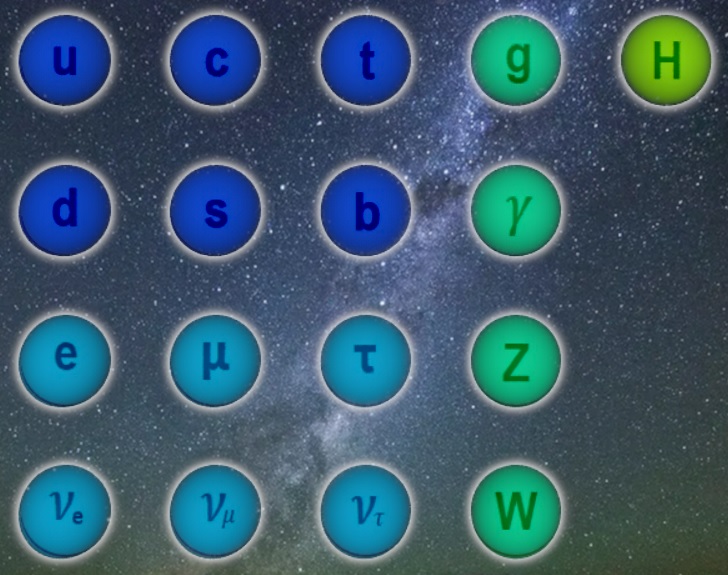
Sometimes the Leptons and Quarks are thought of as “matter particles” and the Bosons are thought of as “force particles”.
Quarks (
- u – up
- d – down
- c – charm
- s – strange
- t- top
- b- bottom
Leptons (
Gauge Bosons (
Scalar Bosons (
Building “stuff”
Proton
A proton is two up quarks, one down quark and the gluons involved in binding the three quarks together. Three quarks must be of three different colors with each cork having a unique color, but there is no specification requiring s particular quark to take a certain color.
Neutron
A free Neutron will break down into a proton, an electron and an antineutrino and the half-life for this is 614 seconds.
Electron
An electron that is free, that is to say it is not in an orbit around a nucleus, appears to be unsplittable. Therefore it is considered to be an elementary particle.
 Rob Sterling